Scale, Steppe Weather and Mountain Pockets
Kazakhstan is not one destination with a climate. It is a continent disguised as a country: steppe, desert, canyons, lakes, cities, ski slopes and high mountains held together by distance. The weather question is never only “Will it be warm?” It is “How much country are you trying to cross, and what will the open space do to the day?”
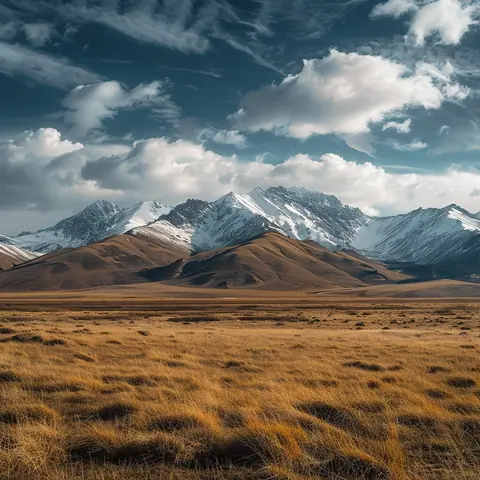
Choose your season by the size of your route
| If your trip depends on… | Best window | Do not force | Nomad’s Land note |
|---|---|---|---|
| Almaty, foothills, canyons and lake routes | May to June; September to early October | Assuming city weather equals mountain weather | Almaty can feel easy while Kolsai, Charyn or high trails ask for different clothing and timing. |
| Steppe and long overland distances | May, June and September | Underestimating wind, exposure and empty distance | The steppe is not a scenic gap; it is part of the route’s difficulty. |
| Desert and canyon landscapes | Spring and autumn | Peak summer heat without shade planning | Heat turns short walks and photo stops into logistics. |
| Winter city and ski combinations | December to March | Road-heavy winter loops without buffer | Winter can be excellent around Almaty and ski areas, but not every road wants to cooperate. |
| Multi-region Kazakhstan travel | Late spring or early autumn | Trying to “see Kazakhstan” in a short, crowded itinerary | Scale is the main weather system. Leave space. |
The thing most travelers get wrong
They think Kazakhstan is a map problem: pick Almaty, add canyons, add lakes, maybe add Astana or the steppe. But Kazakhstan is a distance problem. Weather does not only affect what you see. It affects how long you can stay outside, how tired transfers feel, how exposed the steppe becomes, and whether a route still has rhythm.
When not to go, unless you know why
- July and August for exposed desert or steppe-heavy routes: possible, but heat and distance need honest pacing.
- Deep winter for wide overland touring: strong for specific winter experiences, weak for ambitious mixed loops.
- Early spring in the steppe: mud, wind and transition conditions can make the landscape less accessible than it looks.
- Any season with too much geography: Kazakhstan does not reward compressed itineraries.
Season by season: what changes on the ground
Spring: March to May
Spring begins unevenly. Cities soften first; steppe and mountain areas can remain raw, windy or muddy. By May, Kazakhstan becomes much more usable for Almaty, canyons, foothills and cultural travel.
Summer: June to August
Summer opens mountain lakes and highland routes, but it also exposes the country’s scale. Heat matters outside the mountains. Transfers should not be treated as empty time; they are where comfort and route design are tested.
Autumn: September to November
September is often Kazakhstan’s cleanest travel month: softer heat, good mountain access, stronger light and less strain. October can still work well in southern and southeastern routes. November becomes more transitional and less predictable.
Winter: December to February
Winter belongs to snow, city atmosphere and specific mountain products, especially around Almaty. It is not ideal for broad exploratory touring unless the route is designed with short days, cold and road uncertainty in mind.
How season changes the route
- Almaty – Charyn – Kolsai – Kaindy: best in late spring, summer and early autumn, with mountain layers even when Almaty is warm.
- Astana and northern steppe: more comfortable in late spring and early autumn; winter is severe and should be chosen deliberately.
- Mangystau and desert landscapes: spring and autumn are strongest; summer requires careful heat management.
- Cross-border Silk Road routes: match Kazakhstan’s scale with neighboring country seasons; do not let borders dictate an impossible pace.
Weather reference: Almaty is a gateway, not a national forecast
Almaty data helps with southeast Kazakhstan planning. It does not represent the northern steppe, Mangystau, Astana, desert basins or high mountain pockets. Use it as one anchor in a very large country.
| Month | Average High (°C) | Average Low (°C) | Precipitation (mm) | Sunny Days | Partly Cloudy Days | Overcast Days |
|---|---|---|---|---|---|---|
| January | 0.7 | -8.4 | 29 | 18 | 9 | 4 |
| February | 2.2 | -6.9 | 34 | 17 | 8 | 3 |
| March | 8.7 | -1.6 | 52 | 20 | 7 | 4 |
| April | 17.3 | 5.4 | 68 | 22 | 6 | 2 |
| May | 22.4 | 10.5 | 82 | 25 | 5 | 1 |
| June | 27.5 | 15.4 | 34 | 28 | 2 | 0 |
| July | 30.0 | 17.9 | 21 | 30 | 1 | 0 |
| August | 29.2 | 16.7 | 13 | 30 | 1 | 0 |
| September | 23.5 | 11.7 | 26 | 27 | 2 | 1 |
| October | 15.0 | 5.2 | 49 | 22 | 6 | 3 |
| November | 8.0 | 0.2 | 39 | 17 | 9 | 4 |
| December | 2.1 | -5.3 | 36 | 15 | 10 | 6 |
Source supplied in existing content: Time and Date, Almaty, 2013–2023. Use as a city anchor only; verify against the canonical weather source before production publication.
Do not ask whether Kazakhstan is good in summer. Ask how far you are moving, how exposed the route is, and whether the itinerary has enough space for the country’s scale.