Samarkand Region

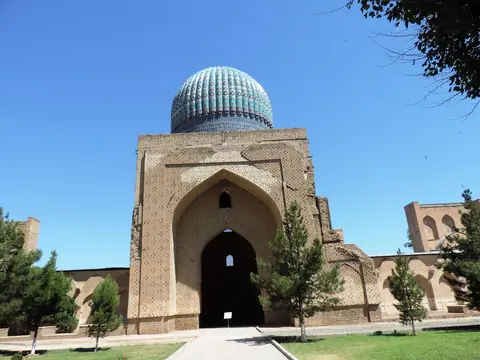
Bibi-Khanym Mosque

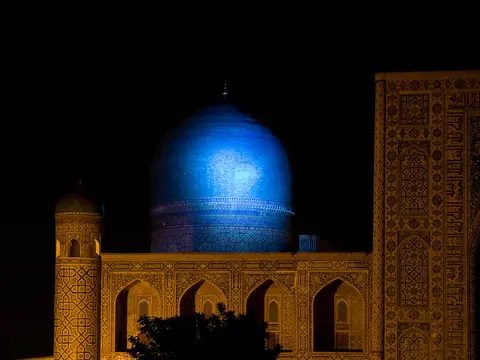
Another decoration of Samarkand is the Bibi-Khanum Mosque, a holy monument of the 15th century. It is believed that the mosque was built by order of Tamerlane, who returned from India with a triumphant victory. The great commander wanted to build a monument for life testifying to his victories.

Samarkand
Samarkand
Uzbekistan
Shah-i-Zinda

Shah-i-Zinda ("living tsar") is a monument of medieval architecture in Samarkand (Uzbekistan), a set of mausoleums of the Karakhanid and Timurid nobility. The existing complex consists of eleven mausoleums, successively attached to each other during the fourteenth and fifteenth centuries. Nevertheless, during the excavations on the eastern slope of the city of Afrasiab, remains of mausoleums of the XI—XII centuries were discovered. In 2001, all the mausoleums of Shah-i-Zinda and other ancient buildings of Samarkand are included in the UNESCO World Heritage list.

Samarkand
Samarkand
Uzbekistan

Ulugbek Observatory Museum

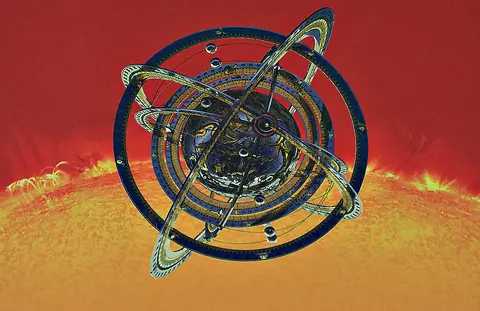
The observatory of Samarkand was built in the 1420s by the Timurid astronomer Ulugh Beg, it is considered by scholars to have been one of the finest observatories in the Islamic world. 
The remains of the observatory were found and studied by archaeologist V.L. Vyatkin in 1908. A study of one of the 17th century documents yielded a precise description of the location of the observatory.

Samarkand
Samarkand
Uzbekistan

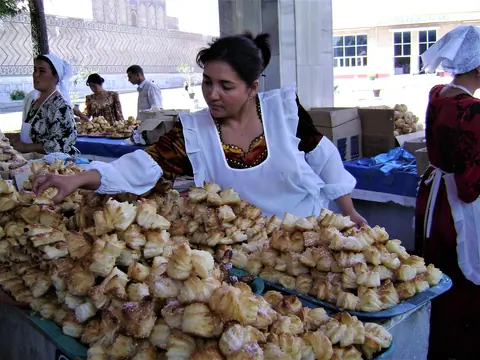
Siab Bazaar

Siyob Bazaar , also called Siab Bazaar, is the largest bazaar in Samarkand, Uzbekistan. All daily necessities, such as "Samarkand naan", are sold. Siyob Bazaar is located adjacent to the Bibi-Khanym Mosque, and is visited not only by local people but also by domestic and foreign tourists.

Samarkand
Samarkand
Uzbekistan

Gur-e Amir Mausoleum

The Gur-e Amir (or Guri Amir) is a mausoleum of the Asian conqueror Tamerlane (also known as Timur) in Samarkand, Uzbekistan.

It occupies an important place in the history of Persian-Mongolian Architecture as the precursor and model for later great Mughal architecture tombs, including Humayun's Tomb in Delhi and the Taj Mahal in Agra

Samarkand
Samarkand
Uzbekistan

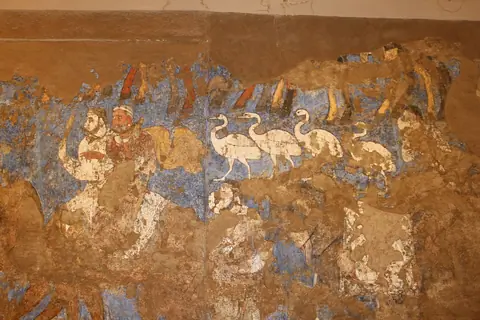
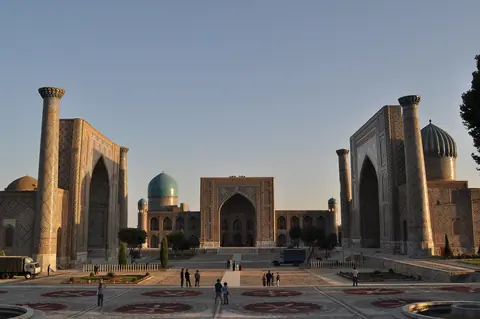
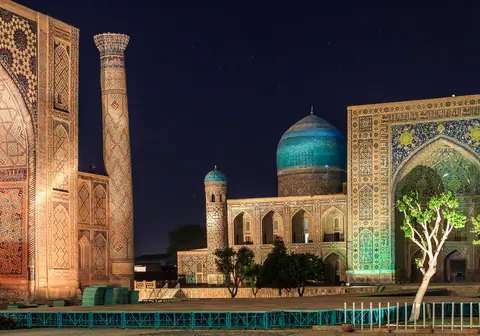
Samarkand is famous for its surprisingly long history - it is one of the oldest cities in the world, founded 8 centuries BC. In the old days, this city was the most important point connecting East and West, and the Silk Road passed through Samarkand. Therefore, here, as nowhere else, a huge number of cultural and historical monuments have been preserved - such as mausoleums, museums, mosques, the ruins of ancient settlements and much more.

Samarkand was proclaimed in 2001 by UNESCO crossroads of cultures and world heritage site.

Geo

Contains