City
Bukhara
Bukhara beyond the checklist
- Territory type
- City
- Elevation
- 225 m
Territory notes
The field account
Bukhara is an administrative area in Uzbekistan, useful for organizing Uzbekistan routes and place content.
In the shade of mulberry trees, the city of Bukhara was an important stop on the Silk Road. A museum city that testifies to the rich past of Central Asia.
Bukhara- Buqaraq of the sogdienwhich would mean "fortunate place" and Vihara in Sanskrit which means a Buddhist monastery.
It is a city in Uzbekistan, located in the south-central part of the country. It is located on the lower reaches of the Zarafshan River, in the middle of an oasis, on the eastern edge of the Kyzyl Kum desert. It was connected by caravan routes to Mervet to the valleys of the rivers Amu-Darya and Syr-Darya (Naryn)
In the ninth century, the city becomes the capital of the Persian Samanid dynasty (875-999) and the appearance of the city is changed again: eleven access gates are observed, the "rabad" (suburb) extends around the inner part ("chakhristan"), the population increases significantly, professions determine the place of residence, many mausoleums and mosques are built (including the mausoleum of the Samanids)
In 999, the city was invaded by the Qarakhanids. At that time, monuments, still visible today, were built: the minaret of Arslan-Khana (Kalian minaret), the mosque of Magoki-Attari, the mosque of Namezgokh, the mausoleum of Chashma-Ayub (the source of Job)
Bukhara gave its name to the bougran, a strong canvas used in the lining of clothes, spelled boquerant by Marco Polo.
Bukhara is also the generic name given to Turkmen carpets, the main trading center of which is the Ashgabat Bazaar. These carpets are subdivided into teke andyomouth, the names of the two main Turkmen tribal families. Their very typical style can be easily recognized because the decoration of the field consists of the repetition of the same decorative motif, the goul, emblem of the weaver tribe.
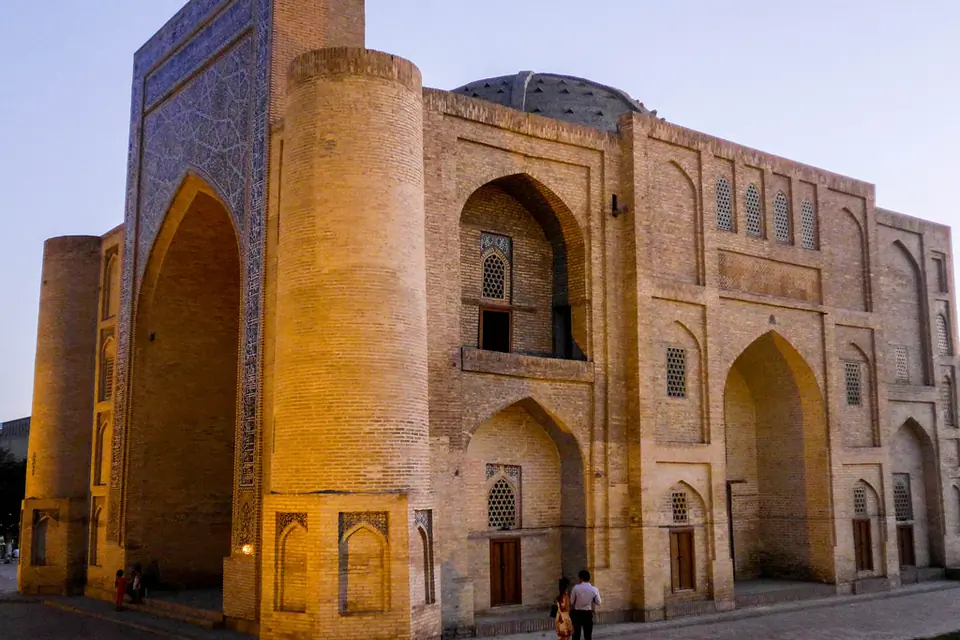
The 140 monuments protected by UNESCO testify to the historical and cultural richness of this city.
The Ark Citadel
The Bolo Hauz Mosque
The Magok-i-Attari Mosque
The Po-i-Kalon complex
The Koch madrasas etc
Map margin
Where it sits
The map marks an orientation point for this territory; it does not describe its boundary.
Geographic index
Within this territory
24 destinations in the catalogue
-
Kalon Minaret
Sacred Place · 46 m
-
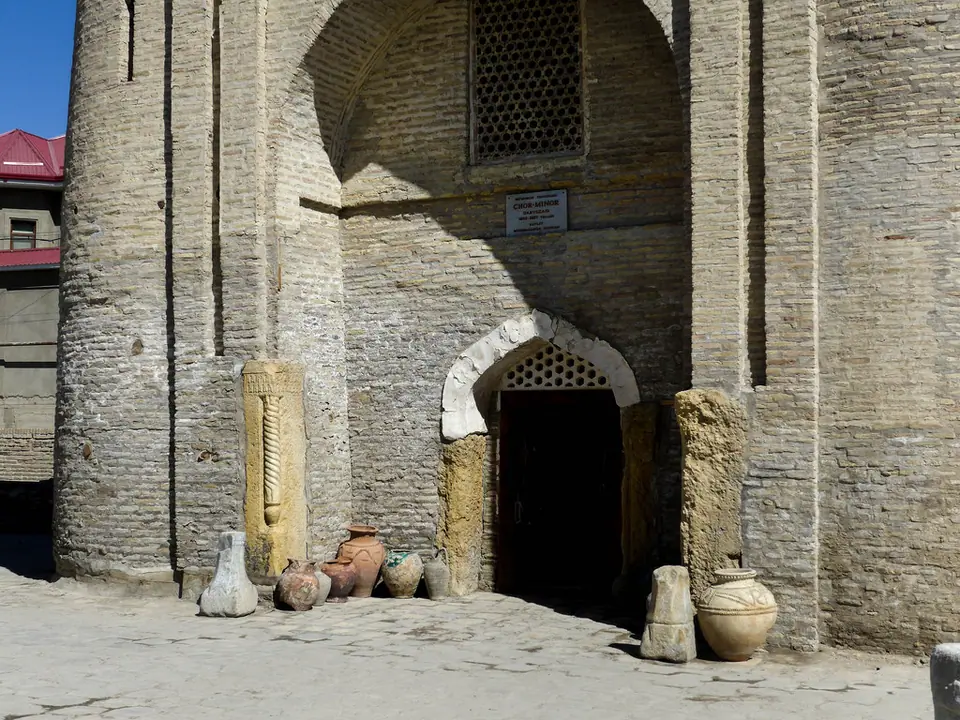
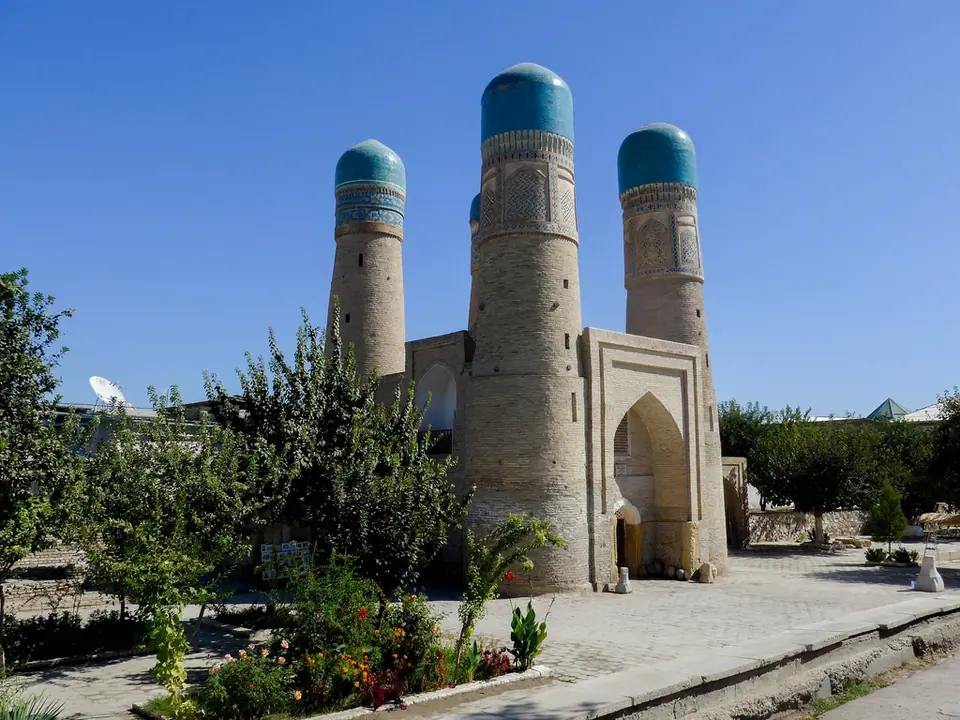
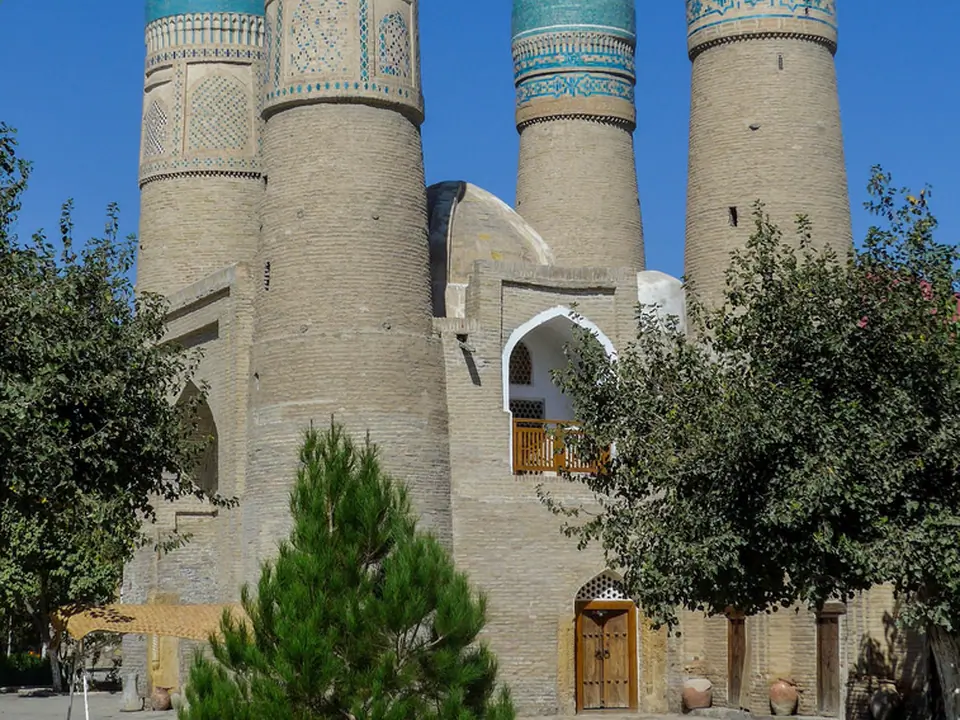
Chor Minor
Sight · 231 m
-
Maghoki-Attar Mosque and Carpet Museum
Museum · 230 m
-
Abdulaziz Khan Madrasah
Sacred Place · 622 m
-
Namazgah mosque
Sacred Place · 220 m
-
Nadir Divan-Begi Madrasah
Sacred Place · 234 m
-
Lyab-i Hauz Complex
Sacred Place · 234 m
-
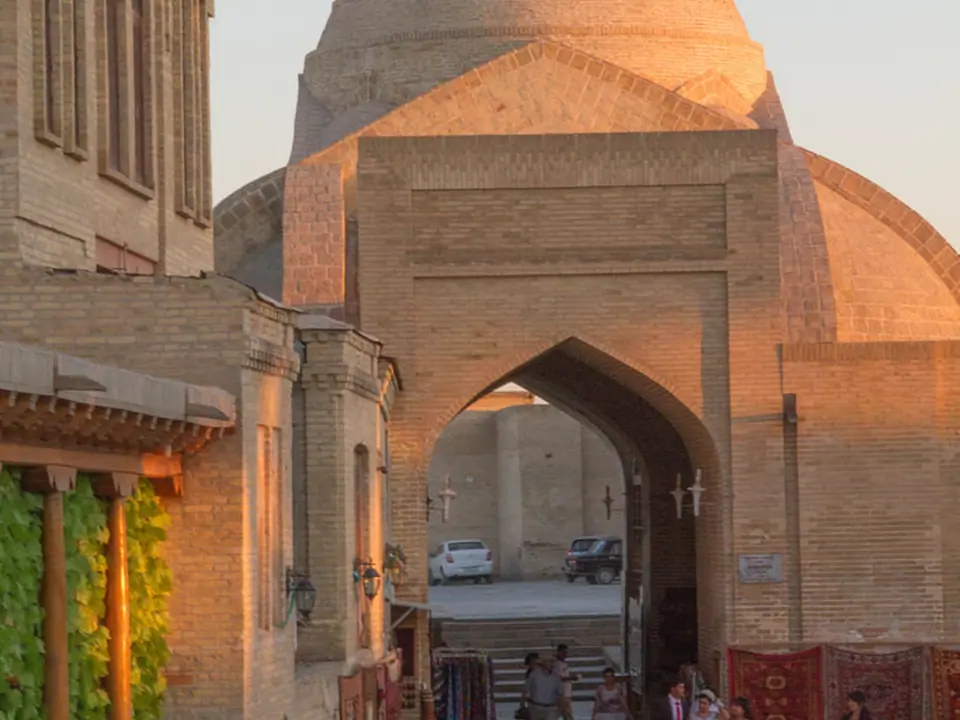
Bukhara Trading Domes
Bazaar · 237 m
-
Bolo Hauz mosque
Sacred Place
-
Chashma-Ayub Mausoleum
Sacred Place · 230 m
-
Bahauddin Naqshband Memorial Complex
Historical Site · 230 m
-
Tim Abdulla Khan trading dome
Bazaar · 237 m
-
Taki Sarrafon Trading Dome
Bazaar · 230 m
-
Maghoki-Attar Mosque
Sacred Place · 235 m
-
Poi-Kalyan Complex
Sacred Place · 230 m
-
The Ark Fortress of Bukhara
Historical Site · 240 m
-
Emir's Summer Residence Sitora Mohi-Khosa
Historical Site · 225 m
-
Mir-i-Arab Madrasa
Sacred Place
-
Kalon Mosque
Sacred Place · 235 m
-
Kalon Minaret
Sacred Place · 230 m
-
Handicraft El-Nur
Cultural Site · 650 m
-
Handicraft Art House Sadosh
Cultural Site · 580 m
-
Bukhara International Airport
Airport · 225 m
-
Ismail Samani Mausoleum
Sacred Place · 231 m
Visual field notes
A closer look