Nukus
Kokand is a city in the Ferghana Province of Uzbekistan. Kokand had a population of about 220,000 in 2010. Little-known city, but very rich historically. Its existence is described by Chinese ambassadors a century before our era. Crockery has been found, dating from the 1st and 2nd centuries BC. Like other great conquerors, the Ferhana Valley was an oasis in the middle of deserts and mountains. Genghis Khan had made it one of his main residences. From the beginning of the 18th century to the end of the 19th century. Kokand had become the capital of a kingdom larger than France.
Margilan is a city in Fergana Province in eastern Uzbekistan. According to European legend, Margilan was founded by Alexander the Great. On a lunch stop, he was given chicken and bread from which the town took its name. More reliable records indicate that Margilan was an important stop on the Silk Road by the 9th century AD, along the route going across the Alay Mountains to Kashgar.
Ferghana is a flourishing city located in the far east of Uzbekistan. It is located in the southern part of the vast Fergana Valley – the most fertile, picturesque and densely populated region of Central Asia.
Fergana, which just recently turned 140 years old, does not belong to the world-famous tourist cities of this country, such as Samarkand, Khiva or Bukhara.
However, acquaintance with ancient monuments here is successfully replaced by traveling through incredibly beautiful surroundings and excursions to nearby cities rich in historical and cultural attractions.
Richtan is a city in the south-west of the Ferghana Valley of Uzbekistan. Richtan is one of the most famous hearths of ceramic production in Uzbekistan whose work, according to tradition, was introduced in the twelfth century, relying on a rich vein of quality clay found in the basement at a depth of about 1.5 m.
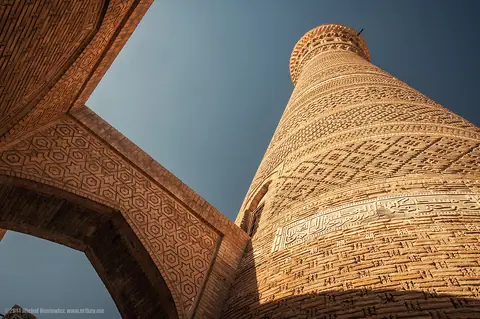
The Kalon Mosque or Kalan, which means "great Mosque", is the former main mosque of Bukhara in Uzbekistan. It was decommissioned for worship in 1924. Listed as a UNESCO World Heritage site, like the entire historical center of the city, it was built at the beginning of the sixteenth century under the Chaybanids on the site of an ancient twelfth-century Friday mosque. It could accommodate twelve thousand people. It is the most important Transoxiana mosque by its dimensions after that of Bibi-Khanum (1399-1404) in Samarkand. It is located opposite the Mir-i Arab Madrasah.
Bukhara
Bukhara
Uzbekistan
The Gur-e Amir (or Guri Amir) is a mausoleum of the Asian conqueror Tamerlane (also known as Timur) in Samarkand, Uzbekistan.
It occupies an important place in the history of Persian-Mongolian Architecture as the precursor and model for later great Mughal architecture tombs, including Humayun's Tomb in Delhi and the Taj Mahal in Agra
Samarkand
Samarkand
Uzbekistan
The Samanid mausoleum is located in the historical urban nucleus of the city of Bukhara, in a park laid out on the site of an ancient cemetery.
Bukhara
Bukhara
Uzbekistan
On the Uzbek lands between the Amu Darya and Syr Darya rivers there is a large Asian desert - Kyzyl Kum. In addition to Uzbekistan, Kyzyl Kum partially extends into the lands of Turkmenistan and Kazakhstan, occupying a total area of 300 km2. Despite the sluggishness of the sandy massifs, the drought and a strongly continental climate, the flora and fauna are quite diverse, especially with the onset of spring, when the amount of precipitation increases.
Bukhara
Bukhara
Uzbekistan
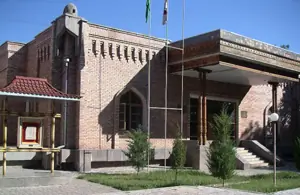
International Caravanserai of culture Ikuo Hirayama in Tashkent is a unique object, which is both a museum and a scientific and cultural center.
Tashkent
Tashkent
Uzbekistan