Uzbekistan

Code value
UZ
Nationality
Uzbek
Path Element
uzbekistan
Adjective
Uzbek

Maghoki-Attar Mosque and Carpet Museum

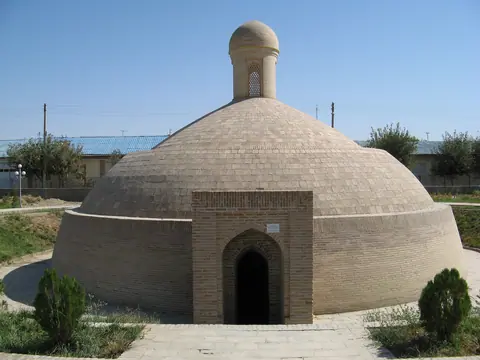
Carpet Weaving Museum. The exposition of the carpet museum was opened in 1991 in the ancient mosque of  Maghoki-Attar(XVI century) near the ancient Shahrud canal, in the center of the old city, next to the dome of the Sarraphon money changers. Before the invasion of the Arabs (VIII century), there was a bazaar at this place, where idols, medicinal drugs and spices were sold. There was also a temple of fire worshippers "Moss" ("temple of the moon").

Bukhara
Bukhara
Uzbekistan
Termez

Termez (or Termiz) is one of the oldest cities in Central Asia: it is over 2,500 years old. In 2014 Termez was awarded the Order of Amir Timur. It is located in the extreme south of Uzbekistan on the northern border of Afghanistan, an important passage between these 2 countries.

Guliston

Gulistan or Guliston is a city of 100,000 inhabitants and it is the administrative center of the Syrdarya region in Uzbekistan. In Persia, Gulistan means the "land of flowers"

In the 19th century, the city developed on the village of Achchikkuduk ("a well with salt water"), in which there were 40 courtyards, there was a mosque and a tea room.

In 1869, by decree of the Governor General of Turkestan KP Kaufman, the possibility of irrigating the starving steppe was studied and in 1886 the construction of the great canal began.

Qarshi

The city of Karshi or Qarchi developed from a colony which was established from the 7th century BC. It was then that defensive walls began to be built around the ancient city. The remains of the ruins of these walls were first studied by archaeologists in 1999.

There is evidence that the city at this time had the Sogdian name Navtak, which can literally be translated as "New Building". As part of the Greco-Bactrian kingdom, the city may have been called Eucratideus.

Jizzakh

Jizak (or Jizzax / Jizzakh) is the administrative center of the Jizzakh region, a city of regional subordination of 180,000 inhabitants. A major transport hub, economic, scientific, educational and cultural center of the region. Located on the highway between Tashkent and Samarkand. It is also connected to these towns by a railway line. It is located on the northern foothills of the Nuratau Ridge, on the Sanzar River, in the southern part of the Mirzachul Steppe. It was founded in the 10th century, in an oasis rich in vegetation, as an important transit point on the Great Silk Road.

Tash Hauli

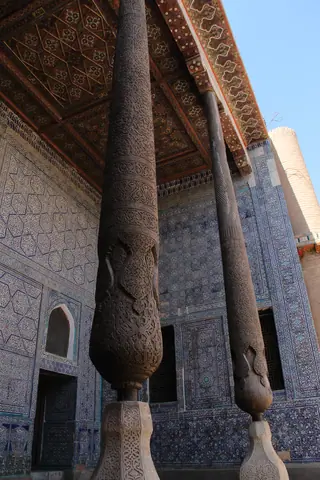
Toshhovli Palace (Uzbek: Toshhovli saroyi, meaning “Stone Courtyard Palace”) is one of the most impressive royal residences in the historic city of Khiva. Located inside the walled inner town of Itchan Kala, the palace was built between 1830 and 1838 during the reign of Allakuli Khan, one of the most powerful khans of the Khiva Khanate. The khan ordered its construction because he wanted a residence that was more private and luxurious than the older royal citadel, the Kunya Ark.

Khiva
Khorezm
Uzbekistan

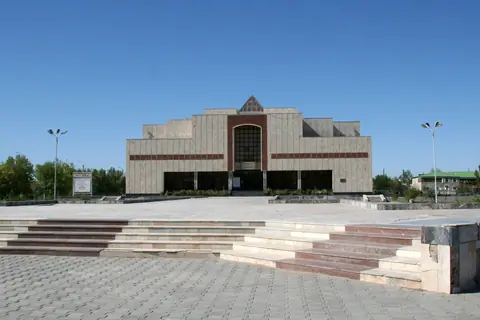
Nukus Museum of Art

The State Art Museum of the Republic of Karakalpakstan, named after I.V. Savitsky is an art museum based in Nukus, Uzbekistan.

Opened in 1966, the museum houses a collection of over 82,000 items, ranging from antiquities from Khorezm to Karakalpak folk art, Uzbek fine art and, uniquely, the second largest collection of Russian avant-garde in the world.

Nukus
Karakalpakstan
Uzbekistan